2026 Workshop
View the 2026 Workshop Program to see the Agenda, Speaker Biographies, and Session Descriptions.
Housing Trends Shaping the Capital Region: What Local Officials Need to Know
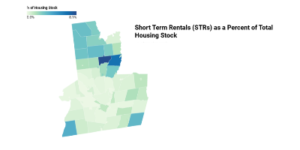
This plenary session highlighted findings from a series of recent housing studies conducted by Capital District Regional Planning Commission in partnership with the Capital Region Transportation Council. Presenters explored regional trends in housing affordability, the growth and geographic concentration of short-term rentals, emerging opportunities and policy considerations related to accessory dwelling units (ADUs), and the continuing expansion of multifamily housing development throughout the region. The session also introduced findings from CDRPC’s newest research examining the relationship between multifamily housing growth and transit accessibility, including how development patterns could influence future transportation demand and regional mobility. Recent analysis found that the majority of both completed and proposed large multifamily developments were occurring outside areas identified as most supportive of transit service, raising important questions about future land use and transportation planning.
Participants gained a data-driven understanding of how housing trends varied across the Capital Region and left better equipped to evaluate development proposals, update local policies, and support housing solutions that balanced community character, affordability, economic growth, and transportation needs.
Session Speakers: Sandy Misiewicz & Mark Castiglione
Short-Term Rental Regulations
Short-term rentals have been around for years, but the availability of online booking sites and the growth of local management companies have had dramatic effects on neighborhoods across the state (and around the world). A number of cities, towns, and villages in New York have come up with a variety of means to permit or restrict short-term rentals consistent with the character of the respective communities. This session looks at the problems short-term rentals posed for several of those municipalities and summarizes the regulations with which they responded to the challenge
Session Speakers: Monica Ryan & Jasleen Jaspal
Site Plan Review – What to Look For, What to Ask
At its core, site plan review is about understanding how a proposed project will actually work on the ground. This session took planning board members through the essentials of site plan review – from understand what site plan review is (and isn’t) to reading the plans, asking the right questions, and making a well-supported decision. We looked at what to pay attention to on a site plan such as access, parking, circulation, landscaping, environmental resources, and neighboring properties, as well as process including hearings, SEQR, and County 239-m review. The session also walked through the review process, discuss the roles of the application, planning board, consultants, and public, and explored how to create a clear record for decision-making. Participants gained practical tips that planning board members can bring back to their next application review.
Session Speaker: Nan Stolzenburg
Policy in Transition: What Does This Mean for Planners
This roundtable discussion explored how anticipated reforms to the State Environmental Quality Review Act (SEQRA) process may affect local decision-making and public engagement. Especially related to new and emerging technologies and changing infrastructure needs like solar, battery storage, and Data Centers. The discussion also examined New York State’s increasing focus on housing affordability and housing supply through initiatives intended to encourage residential development, transit-oriented development, and mixed-use growth patterns while addressing exclusionary zoning and infrastructure constraints. Panelists discussed the evolving role of planners as advocates, facilitators, and technical advisors within increasingly complex and often politically charged policy discussions.
Session Speakers: Terresa Bakner, Ken Kovalchik, Steve Feeney, Frank Barbera, Jen Ceponis & Mark Castiglione
Area Variance: A Deep Dive
Area variances are the most frequent appeal before most zoning boards of appeals. This course is a thorough exploration of each factor of the area variance test with examples and discussion of details often missed and concepts often misunderstood. Tips and best practices for review, decision-making, and documentation, with several court case examples that address key legal considerations and challenges were reviewed.
Session Speakers: Monica Ryan & Jasleen Jaspal
Avoiding Article 78 Challenges: Building Defensible Land Use Decisions
Article 78 challenges are risks facing planning boards, zoning boards of appeals and other local land use bodies. While no Board can eliminate the possibility of litigation, most challenges can be avoided through sound procedures, complete records, clear findings and well-reasoned decision-making. In this practical session, veteran municipal attorney Mark Schachner discussed the most common procedural and substantive mistakes that lead to successful Court challenges and provide strategies for creating legally defensible land use decisions. Topics included public hearing practices, SEQRA compliance, record development, findings and Resolutions, conflicts of interest and due process considerations. Participants gained actionable guidance to help ensure that Board decisions are fair, transparent and capable of withstanding judicial review.
Session Speakers: Mark Schachner
Case Law Update
Recent decisions from New York State courts continue to shape the legal landscape for land use, zoning, and development review. This session provides planning and zoning board members with key case law updates that directly impact how municipalities interpret and apply zoning regulations, conduct site plan and special use permit reviews, and manage public hearings and procedural requirements.
Session Speaker: Javid Afzali
Local Climate Action Planning
This session offered a practical review of how municipalities can develop and implement effective climate action plans. Participants learned the basics of government operations greenhouse gas inventories, setting GHG reduction targets, and identifying mitigation measures they can undertake to reduce GHG emissions from their government-controlled operations. This session also explained the differences between government operations and community wide inventories and plans. It reviewed how municipalities can interpret their community-wide GHG emissions from the recently completed Capital Region GHG inventory and how they can use this data along with the new Capital Region Climate Action Plan as a starting point for developing their own community-wide climate action plans.
Haley Balcanoff: Climate Action Plans for Government Operations
Jim Yienger: Community Climate Action Plans
Session Speakers: Jim Yienger & Haley Balcanoff
Unlocking Housing Choices
This session offered planning and zoning board members, local leaders, and community planners practical strategies to update local land use regulations to expand housing opportunities. Moving beyond a one-size-fits-all approach, we examineed the full spectrum of regulatory reform – from minor code tweaks and “gentle density” (such as accessory dwellings, duplexes, and right-sized lot and parking standards) to larger-scale overhauls, commercial corridor retrofits, and mixed-use revitalization. Attendees also learned effective methods to audit existing land use patterns, evaluate current zoning barriers, and meaningfully engage residents and stakeholders to build local consensus around housing solutions tailored to their community.
Session Speakers: Matthew G. Rogers & Mirren Galway
Online Tools for Sustainability Planning
This session provided an overview of CDRPC’s online Climate Action Portal and Natural Resource Inventory (NRI) Mapper, showcasing how these tools supported climate action, sustainable land use planning, and Natural Resource Inventory development. As a visual and dynamic interface to the Capital Region Climate Action Plan, the Climate Action Portal included a wide variety of indicators illustrating municipal climate actions across the Capital Region and how these actions helped achieve the plan’s goals. The session also provided a tutorial on how municipalities could use the Natural Resource Inventory Mapper to review development proposals within the mapped context of the natural resources present at a development site. In addition, the session demonstrated how municipalities could use the NRI Mapper to develop their own community NRIs, including how to access and use the ready-made maps and templates available in the application.
CDRPC’s Capital Region Natural Resources Inventory Mapper: Capital Region Natural Resource Inventory (NRI) Portal – CDRPC
CDRPC’s Capital Region Natural Resources Inventory Template (Word): Natural-Resources-Inventory-Report_NRI_Final.docx
Maidson Hrysko Contact: madison.hrysko@cdrpc.org
CDRPC’s Capital Region Climate Action Portal: Capital Region Climate Action Portal
Josh Dranoff Contact: josh.dranoff@cdrpc.org
Session Speakers: Madison Hrysko & Josh Dranoff