Capital Region Rents Jump 15% in One Year, Far Outpacing Wage Growth, New CDRPC Report Finds
New analysis highlights growing affordability challenges for renters and homebuyers across the four-county region
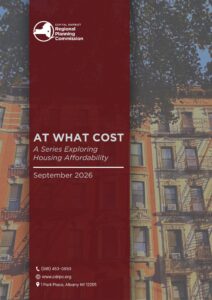
Albany, NY – Housing costs in the Capital Region continue to rise substantially faster than renter incomes, according to a new report released by the Capital District Regional Planning Commission (CDRPC). The report found that Fair Market Rent for a one-bedroom apartment increased 15 percent between 2025 and 2026, while two-bedroom rents increased 14 percent. Both increases exceeded renter wage growth during the same period, widening affordability gaps throughout Albany, Rensselaer, Saratoga, and Schenectady counties.
The report, At What Cost, examines housing affordability trends using data from the U.S. Census Bureau, U.S. Department of Housing and Urban Development (HUD), Bureau of Labor Statistics, National Low Income Housing Coalition, Federal Reserve Economic Data, and New York State Sales Web. The findings show that renters across all four Capital Region counties now earn less than the income needed to afford market-rate housing without becoming housing cost burdened.
“We often talk about housing affordability as a future challenge, but the data show the challenge is already here,” said Mark Castiglione, Executive Director of the Capital District Regional Planning Commission. “Rents are rising much faster than wages, and many working households are finding it increasingly difficult to afford housing without sacrificing something else in their household budget. Housing affordability is no longer simply a housing issue. It is an economic development, workforce, and quality-of-life issue for the entire region.”
“The ALICE data gives us a clearer picture of what financial hardship looks like in our local communities. Many of our neighbors work every day in jobs that are essential to our region, yet too many are still forced to make difficult decisions between childcare, food, housing, utilities, and other basic needs. Understanding that gap and taking action toward closing it is critical. At United Way of the Greater Capital Region, we are determined to help narrow the affordability gap for more families. The more people who understand this data, the more we can work together as partners to develop solutions that create a more thriving region where families have access to stability and opportunity,” said Peter Gannon, President & CEO of United Way of the Greater Capital Region.
Key Findings
- One-bedroom Fair Market Rent increased from $1,230 to $1,417, a 15 percent increase in one year. The increase was larger than any annual increase shown in the report’s historical comparison data.
- Two-bedroom Fair Market Rent increased from $1,487 to $1,702, a 14 percent increase in one year. The increase was larger than any annual increase shown in the report’s historical comparison data.
- Average renter wages increased just 3.9 percent during the same period.
- Renters now need to earn $27.25 per hour to afford a one-bedroom apartment and $32.73 per hour to afford a two-bedroom apartment without becoming housing cost burdened.
- The Capital Region added more than 10,000 renter households between the 2015-2019 and 2020-2024 Census periods, bringing the total number of renter households to 134,273.
The report found that average renter wages fell short of housing costs in every Capital Region County. Albany County renters earned an average of $23.71 per hour in 2026, compared with the $27.25 hourly wage needed to afford a one-bedroom apartment at Fair Market Rent. Schenectady County experienced the largest renter wage gap identified in the report, with renters earning $7.02 less per hour than the amount needed to afford a one-bedroom apartment.
The gap is even wider for larger units. Across the region, renters fall short of the wage needed to afford a two-bedroom apartment by between $9.02 and $12.50 per hour, depending on county.
The findings also show that a single full-time renter would be considered housing cost burdened in every Capital Region County. A one-bedroom apartment would consume between 34 percent and 40 percent of renter income, while a two-bedroom apartment would require between 41 percent and 49 percent of income, exceeding the commonly accepted affordability threshold of 30 percent.
The report estimates that renters would need to work beyond a traditional 40-hour workweek to afford housing at Fair Market Rent. Depending on location, renters would need to work between 42 and 44 hours per week to afford a one-bedroom apartment and 45 to 47 hours per week to afford a two-bedroom apartment.
“Housing and transportation are often a household’s two largest expenses,” said Sandy Misiewicz, Executive Director of the Capital Region Transportation Council. “When housing becomes less affordable, families are often forced to make difficult choices about where they live, how far they commute, and how they access jobs, schools, healthcare, and other services. Understanding these trends is essential to planning a region that remains accessible and affordable for everyone.”
Homeownership Challenges Persist
The report also found that homeownership remains out of reach for many households, particularly in higher-cost housing markets. Using Area Median Income (AMI) benchmarks and 2025 home sale prices, the analysis found that a single-person household earning 70 percent of AMI could not afford a median-priced home in Albany or Saratoga counties. A two-person household earning 80 percent of AMI could afford a median-priced home in Albany, Rensselaer, and Schenectady counties under the report’s assumptions, but not in Saratoga County.
The full report is available from the Capital District Regional Planning Commission.
For additional information or interview requests, contact the Capital District Regional Planning Commission.
###
About the Capital District Regional Planning Commission
The Capital District Regional Planning Commission provides objective analysis of data and trends to help identify opportunities and challenges affecting Albany, Rensselaer, Saratoga, and Schenectady counties. Through regional planning, technical assistance, data analysis, and partnership development, CDRPC supports local governments and regional initiatives that enhance the Capital Region’s quality of life and economic vitality.